
Guest contribution · Shopify & AI visibility
How Do You Know If AI Can Find and Recommend Your Shopify Products?
A practical guide to testing real shopper prompts, improving product clarity, comparing competitor visibility, and measuring Shopify recommendations across AI search.
September 29, 2026 · 11 min read · Guest contribution by Sell The Trend
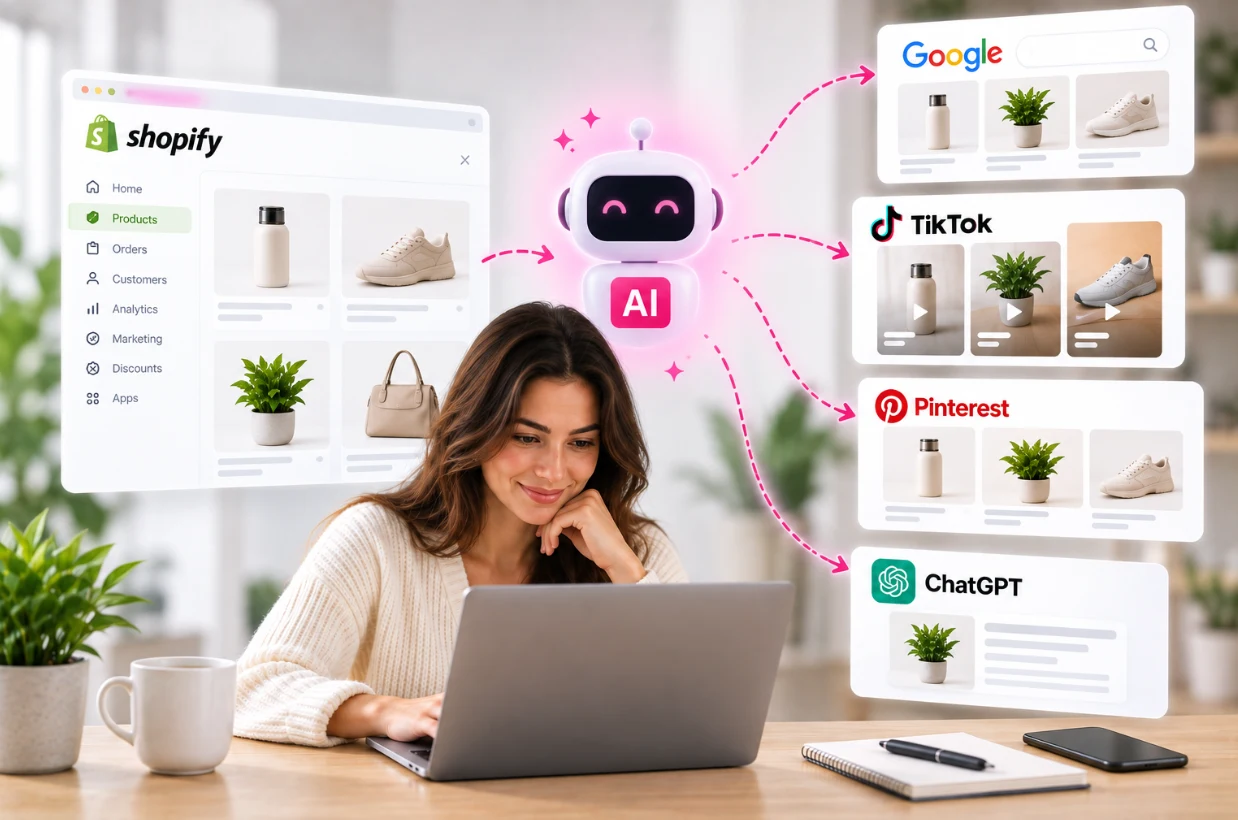
The simplest way to know whether AI can find and recommend your Shopify products is to test the real questions shoppers might ask and track whether your products appear in the answers.
But visibility alone is not enough. AI systems also need clear, consistent information about what you sell, while your products need enough real-world relevance to deserve consideration in the first place.
The strongest strategy combines product demand, well-structured store content, and ongoing AI visibility monitoring.
Chapter 01
AI Is Becoming Part of the Ecommerce Workflow
AI is increasingly appearing throughout ecommerce, from product research and store creation to marketing, competitive analysis, and fulfillment.
Sell The Trend’s State of AI Dropshipping examines this broader transition and how AI-assisted workflows are changing the way merchants research opportunities and operate ecommerce businesses.
That matters because product discovery is evolving on both sides of the transaction: merchants are using AI to decide what to sell, while customers can use AI to decide what to buy.
For Shopify stores, the opportunity is to make sure the information AI encounters about a product is clear enough to understand, while recognizing that no individual optimization can guarantee a recommendation.
“best portable blender”
Ranked links
“What compact blender works for a small apartment?”
Synthesized recommendations
Chapter 02
Being Visible on Google Doesn’t Mean You’re Visible to AI
For years, ecommerce visibility followed a familiar path. A shopper searched Google for “best portable blender,” “gifts for dog owners,” or “waterproof hiking backpack.” Merchants optimized pages around those searches and tried to move higher in the results.
AI shopping changes that journey. A shopper can ask a much more specific question: “I’m traveling through Europe for three weeks. What compact backpack would you recommend that fits under an airline seat?”
Instead of presenting a page of links, an AI system may synthesize information from multiple sources and suggest a smaller set of options. That creates a different question for Shopify merchants: does AI understand your products well enough to consider them when answering?
A store can have attractive product pages, strong branding, and good traditional SEO while still rarely appearing in AI conversations around its market. AI visibility therefore needs to be examined separately instead of assumed from existing search performance.
Chapter 03
Start With the Questions Your Customers Would Actually Ask
If you want to know whether AI can find your products, do not begin with “Do you know my store?” That is not how most customers shop. Start with buying questions.
Pet products: “What’s a good car seat cover for a dog that sheds heavily?”
Kitchen products: “What are some useful kitchen gadgets for a small apartment?”
Skincare: “What should I buy for a simple travel skincare routine?”
These questions reveal something traditional keyword tracking can miss: context. Customers describe a problem, situation, budget, preference, or desired outcome rather than always using an exact product name.
Build a small set of prompts around the reasons someone would buy your products. Include discovery questions, problem-solving questions, comparisons, use cases, budgets, and important features. Then repeat those tests over time.
One AI response is a snapshot. Repeated observations are much more useful for understanding whether visibility is changing.
Example product
The Arctic Breeze™
A brand name alone does not explain what the product is. Add concrete attributes that make the offer unambiguous.
Chapter 04
Make Your Products Easy to Understand
Suppose you sell a rechargeable neck fan and your product page calls it The Arctic Breeze™. That is a perfectly reasonable brand name for a human shopper who can see the photos.
But the rest of the page also needs to make the actual product unmistakable. Is it wearable? Rechargeable? Hands-free? Designed for travel? How long does the battery last? What is included? Who is it useful for?
Clear titles, descriptions, product attributes, collections, images, policies, and other catalog information give machines more context about what a product actually is.
The goal is not to stuff pages with phrases you hope an AI will notice. It is almost the opposite: create product information that is specific, accurate, useful, and consistent enough that both shoppers and machines can understand exactly what you are offering.
Chapter 05
Good Product Data Can’t Fix a Product Nobody Wants
There is another side to AI visibility that is easy to overlook. You can create an exceptionally clear product page and still have a weak product opportunity. Being understandable does not automatically make something recommendable.
Before investing heavily in visibility for a particular product, merchants can look at current market data to understand demand, competition, margins, supplier conditions, and trend direction.
Sell The Trend’s live dropshipping intelligence reports, for example, are refreshed weekly and cover signals such as fast-growing products, high-margin opportunities, lower-competition products, TikTok Shop activity, AliExpress performance, supplier locations, and shipping characteristics.
You need both perspectives. There is little value in becoming highly visible for something customers have stopped wanting.
Brand mention
Did the answer name your brand?
Product recommendation
Was a product actually suggested?
Citation
Did the answer reference your store or another source?
Competitors
Which competing brands appeared?
Position
Where did your product appear in the answer?
Chapter 06
Mentions, Recommendations, and Citations Aren’t the Same Thing
Imagine asking an AI assistant: “What are some good products for keeping dogs comfortable during long car rides?” Your brand appears somewhere in the answer. Success? Maybe.
Look closer. Did the AI simply mention your company? Did it actually present your product as an option? Did it cite your product page? Which other brands appeared? Where did the information supporting the answer come from?
A brand mention tells you something different from an actual product recommendation. A citation can show which source helped support an answer. Competitor appearances can reveal which brands or products AI systems are associating with the same customer need.
AI visibility therefore should not be reduced to a single yes-or-no metric. You want to understand the context around the appearance.
Chapter 07
Why Checking ChatGPT Once Isn’t Enough
AI answers are not fixed search rankings. Ask a similar question at a different time or through another AI provider and you may receive a different response.
That makes casual manual checking useful for exploration but weak as a measurement system. A better approach is to establish a consistent set of shopper prompts and observe them repeatedly.
- Did your brand appear?
- Was a specific product recommended?
- Which competitors appeared?
- What sources were cited?
- Where did your product appear within the answer?
- Has that changed over time?
Dropstore’s published methodology takes this observation-based approach, treating each AI response as a dated result tied to a particular prompt and provider rather than assuming there is one universal AI ranking.
You are not trying to discover your permanent “ChatGPT ranking.” You are measuring patterns in how your store appears across relevant AI shopping conversations.
Chapter 08
What If Your Competitors Appear and You Don’t?
If competing products repeatedly appear for relevant shopper questions while yours does not, resist the temptation to start randomly rewriting everything. Investigate the difference.
Maybe competitors provide clearer product specifications. Perhaps their collections better establish what they specialize in. Maybe other websites frequently reference their products. Their product pages could answer important questions yours do not. Or perhaps their products simply align more closely with what shoppers are asking for.
Competitor visibility is not proof of one specific problem. It is a clue.
The useful question is not “Why doesn’t AI recommend me?” but “What information or market signals might explain the difference?”
Chapter 09
Turn AI Visibility Into Something You Can Measure
Manually testing prompts is a good place to start, but it becomes cumbersome quickly. That is where a platform like Dropstore becomes useful.
Dropstore is built specifically around AI visibility for Shopify. It can track shopper prompts across OpenAI, Claude, Gemini, and Perplexity and record details such as mentions, recommendations, citations, competitors, sentiment, and position.
It also connects those observations with Shopify catalog and technical audits so merchants can identify product, collection, content, and storefront improvements worth investigating.
Importantly, this is not about pressing a button that guarantees ChatGPT will recommend a product. No legitimate tool can promise that. The value is measurement.
Instead of wondering whether AI can see your store, you can observe how your products actually appear across the questions that matter to your customers and use those observations to decide what deserves improvement.
See how AI visibility tracking worksFAQ
Frequently Asked Questions
How do I check whether ChatGPT can find my Shopify products?
Start by asking realistic shopping questions related to the problems, categories, and use cases your products address. For more meaningful measurement, repeat a consistent set of prompts over time and track mentions, recommendations, competitors, and citations.
Is AI visibility the same as SEO?
No. They overlap, but they are not identical. Traditional SEO generally focuses on visibility within search engines, while AI visibility examines whether and how a brand or product appears within AI-generated answers.
Does structured product information help AI understand my store?
Clear product titles, descriptions, attributes, collections, images, policies, and other consistent catalog information can make your products easier for machines to interpret. That does not guarantee they will be recommended.
Can I guarantee that ChatGPT recommends my products?
No. AI recommendations depend on the particular question, available information, provider, model behavior, and other factors. Store optimization can improve clarity and readiness, but it cannot force a recommendation.
Should I optimize every product for AI visibility?
Start with commercially important products: proven sellers, products showing current demand, strategic collections, and products closely aligned with the questions your target customers are likely to ask.
Final Takeaway
AI product discovery introduces a new challenge for Shopify merchants. It is no longer enough to ask whether customers can find you through traditional search.
Start with products supported by real demand. Give those products clear, accurate information. Test the questions your customers actually ask. Then measure what happens over time.
The objective is not to trick AI into recommending your store. It is to build a store that is easy to understand, backed by products customers genuinely want, and measurable in the new places where buying decisions are beginning to happen.